Text Us
  Call Us
Who Is At Fault In A T-Bone Accident in Virginia?



Key Takeaways
- Fault in a Virginia T-bone accident usually rests with the driver who violated right-of-way rules, such as running a red light or failing to yield.
- Virginia’s contributory negligence rule is strict—any shared fault, even minimal, can completely bar recovery.
- Proving liability depends on fast, thorough evidence collection, including police reports, witness statements, and traffic or surveillance footage.
A T-bone accident, also known as a side-impact collision, occurs when the front of one vehicle strikes the side of another, forming a “T” shape at the point of impact. These crashes are among the most dangerous types of collisions because the side of a vehicle offers far less protection than the front or rear, leaving occupants vulnerable to serious injuries.
In many T-bone accidents, fault may seem obvious at first glance, particularly when one driver clearly ran a red light or failed to yield at an intersection. However, from a legal perspective, determining liability is rarely straightforward. The potential for shared fault, conflicting witness accounts, and complex traffic regulations all mean that establishing who is legally responsible requires careful investigation and analysis.
Who May Be Responsible in a T-Bone Car Accident?
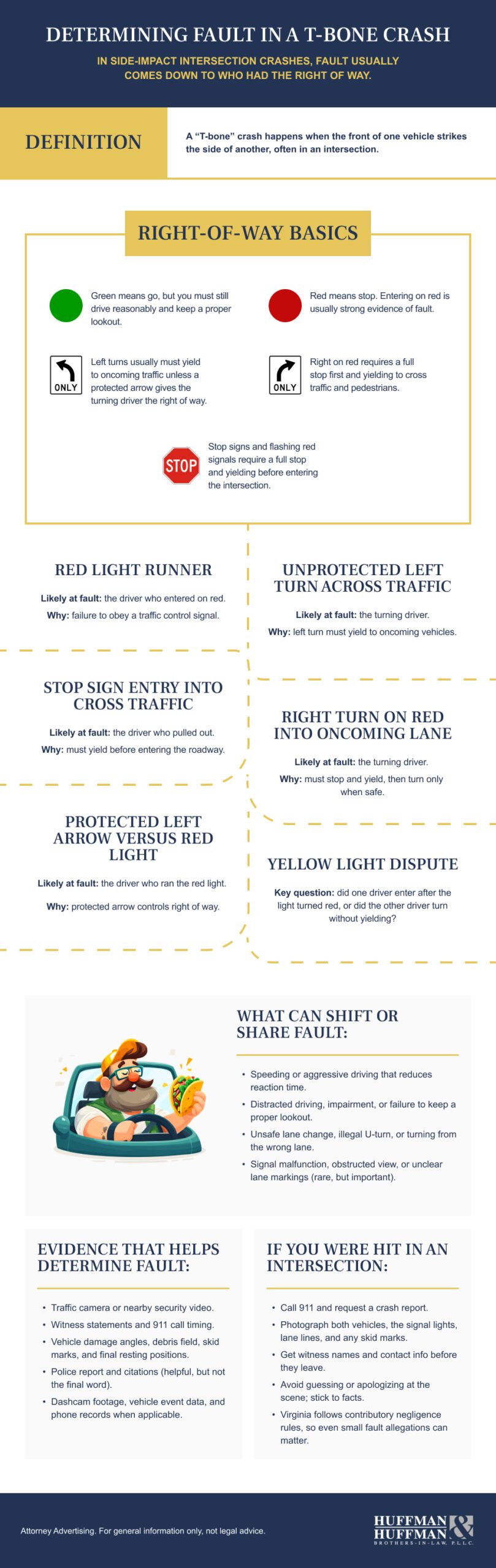
In most T-bone accidents, the at-fault driver is the one who violated right-of-way rules. Virginia traffic laws establish clear guidelines about which vehicles have the right to proceed through intersections, and the driver who fails to follow these rules typically bears responsibility for the resulting collision.
Common scenarios where right-of-way violations lead to T-bone accidents include:
- Running a Red Light or Stop Sign: When a driver fails to stop at a traffic control device and strikes a vehicle that has the legal right to proceed through the intersection, they’re almost always at fault. For example, if Driver A runs a red light and T-bones Driver B, who has a green light, Driver A violated Driver B’s right-of-way.
- Failing to Yield When Turning: Drivers making left turns must yield to oncoming traffic. If a driver turns left in front of an approaching vehicle and causes a side-impact collision, they typically bear fault for failing to yield. Similarly, drivers turning right on red must yield to traffic with the green light.
- Ignoring Yield Signs: At intersections with yield signs, drivers must allow vehicles on the main road to pass before proceeding. Pulling out in front of traffic with the right-of-way can result in a devastating T-bone crash.
- Four-Way Stop Violations: At four-way stops, the vehicle that arrives first has the right to proceed first. When two vehicles arrive simultaneously, the vehicle on the right has priority. Drivers who proceed out of turn and cause collisions may be held liable.
Some of the most common contributing factors that lead to T-bone accidents include:
- Distracted driving: A driver texting, eating, or otherwise distracted may not notice traffic signals or other vehicles
- Impairment: Alcohol or drug use significantly increases the likelihood of failing to obey traffic laws
- Excessive speed: Driving too fast can make it harder to stop in time and may lead to running a red light or failing to yield.
- Weather conditions: Poor visibility or slippery roads can contribute to accidents, though they rarely excuse failing to yield right-of-way
- Mechanical malfunctions: Brake failure, steering problems, or other vehicle issues can make it difficult to stop or steer safely, increasing the risk of a T-bone collision.
Because these accidents often result from clear traffic violations, those injured in a T-bone crash may be able to seek legal remedies.
Can You Sue After a T-Bone Accident?
If you were injured in a T-bone accident caused by another driver’s negligence, Virginia law allows you to file a personal injury claim seeking compensation for your damages. T-bone injuries are often severe due to the limited protection vehicle sides provide. Common injuries in side-impact collisions include broken bones, head and brain injuries, spinal cord injuries, and internal trauma.
When you file a claim, you may recover several types of damages:
- Economic Damages: Medical expenses (emergency care, hospitalization, surgery, rehabilitation, future medical treatment), lost wages and income, reduced earning capacity if you can’t return to your previous work, property damage to your vehicle, and out-of-pocket expenses related to your injuries.
- Non-Economic Damages: Pain and suffering, emotional distress and mental anguish, loss of enjoyment of life, permanent disability or disfigurement, and loss of consortium (impact on your relationship with your spouse).
However, there’s a critical caveat in Virginia: the state’s contributory negligence rule. This rule means that if you share any responsibility for the accident, even just 1%, you cannot recover compensation for your injuries.
For example, a driver with the right-of-way could be argued to have contributed if they were speeding, using a phone, or otherwise distracted, even if the other driver clearly caused the crash. Insurance companies and defense attorneys often look for any opportunity to make this argument, which is why working with an experienced attorney is critical. An attorney ensures evidence is preserved, documents your actions, and protects your claim from attempts to shift blame.
How is Fault Proven?
Proving fault in a T-bone accident requires gathering evidence that clearly shows the other driver caused the crash. The more complete and detailed the evidence, the stronger your case is likely to be.
Key types of evidence used to establish fault include:
- Police Reports: Official accounts documenting the scene, conditions, and any citations issued.
- Eyewitness Accounts: Statements from witnesses and other drivers involved.
- Electronic Evidence: Traffic camera footage, surveillance videos, and traffic signal data.
- Physical Evidence: Vehicle damage, skid marks, and debris patterns at the scene.
- Expert Analysis: Accident reconstruction and professional opinions that clarify how the crash occurred.
Collecting this evidence quickly is crucial, as key details can be lost or degraded over time. An experienced T-bone accident attorney knows what evidence is essential, how to preserve it, and how to present it effectively to establish fault.
How a Virginia T-Bone Car Accident Lawyer Can Help
Having an experienced attorney on your side can make a significant difference in recovering full compensation in your T-bone accident case. A skilled lawyer can:
- Investigate the Accident Immediately: They document the scene, gather witness statements, and preserve evidence before it’s lost.
- Collect and Analyze Evidence: From traffic camera footage to accident reconstruction, they build a clear picture of how the crash happened.
- Establish Fault: By reviewing traffic laws, right-of-way rules, and all available evidence, they ensure the at-fault driver is properly held responsible.
- Document Your Damages: They track medical bills, lost wages, and other losses to support your claim for full compensation.
- Handle Insurance Negotiations: Attorneys deal directly with insurance companies, preventing lowball offers and protecting you from unfair arguments.
- Prepare for Litigation if Needed: If the case goes to court, they develop a strong strategy to present your claim effectively.
With professional guidance, you can focus on recovery while your attorney handles the complex legal and evidentiary challenges that follow a serious T-bone accident.
What to Do After a T-Bone Accident in Virginia
The steps you take immediately after a T-bone collision can significantly impact your health and your ability to recover compensation. Follow these guidelines to protect yourself:
Seek Immediate Medical Attention
Even if you don’t think you’re seriously injured, get evaluated by a medical professional. Some T-bone injuries, like internal bleeding or traumatic brain injuries, may not present obvious symptoms immediately. Delaying medical care also gives insurance companies ammunition to argue your injuries aren’t serious.
Call the Police
Always report the accident and insist on an official police report. This document provides an independent account of the accident and often includes the officer’s determination of fault.
Document Everything
If you’re physically able, take photos of vehicle damage, the accident scene, traffic signals, skid marks, and any visible injuries. Collect contact information from witnesses.
Avoid Discussing Fault
Don’t apologize or make statements about who was at fault, even if you think you might have contributed. These statements can be used against you later. Stick to factual information when speaking with police.
Preserve Evidence
Keep all medical bills, repair estimates, and documentation of missed work. Don’t repair your vehicle until it’s been inspected and photographed.
Consult with an Experienced Car Accident Attorney
Contact a Virginia car accident lawyer as soon as possible. Early legal involvement ensures evidence is preserved, your rights are protected, and you don’t make mistakes that could jeopardize your claim.
Take Your Next Steps After a Crash With Huffman & Huffman
At Huffman & Huffman, our attorneys have extensive experience handling complex side-impact collision cases. We understand how to investigate these accidents, gather compelling evidence, and build cases that clearly establish the at-fault driver’s liability while protecting our clients from unfair blame.
We offer free consultations where we’ll review your accident, explain your legal options, and answer your questions with no obligation. Don’t face insurance companies alone or risk losing your right to compensation because of contributory negligence arguments.
Contact Huffman & Huffman today to learn how we can help you pursue the compensation you deserve.

 Trusted Content
Related Posts
-
 Car Accidents3 mins READ
ARE POLICE REPORTS NEEDED TO FILE A CAR ACCIDENT CLAIM?
In Virginia, you may be required to file a police report after a car accident, especially if there are injuries or significant property damage. Having an official police report can be very helpful when filing an insurance claim or pursuing compensation. That said, you don’t always need a police report to start your claim, but...Read More -
 Car Accidents5 mins READ
Can I Sue as a Passenger in a Car Accident?
Can I Sue as a Passenger in a Car Accident? If you’ve been injured as a passenger in a car accident, you may wonder about your legal rights and options for seeking compensation to cover your medical bills and other damages. Understanding these rights is essential for securing the support and compensation you deserve. Discover...Read More -
 Car AccidentsInsuranceTruck Accidents5 mins READ
10 Steps To Take After A Commercial Vehicle Accident
Semi-trucks, 18-wheelers, and other commercial vehicles (CMVs) are imposing forces on the road. Because of their size and weight as well as the material they may be hauling, they can be intimidating to other drivers on the road. While being in an accident is a traumatic experience, an accident can be even more catastrophic and life-changing if...Read More